







Aryna Sabalenka’s Battle of the Sexes Match Ignites a Polarizing Global Debate
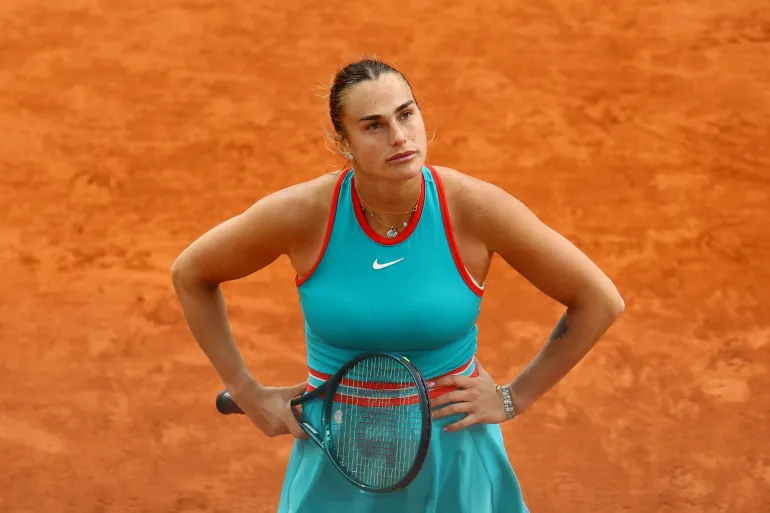
Indian-American author and political commentator Dinesh D’Souza recently weighed in on Aryna Sabalenka’s much-discussed appearance in the so-called “Battle of the Sexes,” an exhibition match that drew global attention in 2025. The event featured Sabalenka facing Australian star Nick Kyrgios, with Kyrgios winning in straight sets, 6–3, 6–3.
The matchup was marketed as a modern reimagining of the historic “Battle of the Sexes,” a concept most famously associated with Billie Jean King’s landmark victory over Bobby Riggs more than five decades ago. While that 1973 match carried deep cultural significance at the height of the gender equality movement, the 2025 version unfolded in a very different social and sporting landscape, fueled largely by debate, curiosity, and controversy.
Sabalenka’s participation alone was enough to spark widespread discussion across tennis circles and social media. As one of the most powerful and successful players on the WTA Tour, her decision to take part in such an exhibition drew praise from some for its boldness, while others questioned the purpose and implications of the matchup. The straight-sets defeat did little to quiet the conversation, instead intensifying broader debates about physical differences in elite sport.
Did Sabalenka make a genius move to expose and discredit all the gender equality and trans lunatics in a single stroke?
— Dinesh D’Souza (@DineshDSouza) December 29, 2025
D’Souza was among the loudest voices reacting to the event. Despite Sabalenka’s loss, he credited her for agreeing to compete, arguing that the match reinforced what he sees as a clear physical gap between elite male and female tennis players. From his perspective, the outcome supported his long-held opposition to transgender women competing in women’s sports — a topic he has frequently addressed in political and cultural commentary.
In a strongly worded statement shared publicly, D’Souza framed Sabalenka’s participation as a defining moment in the ongoing debate, suggesting that the match undermined claims of absolute gender parity in elite athletics. His remarks quickly circulated online, drawing both agreement and criticism, and once again placing the Belarusian star at the center of a conversation that extended far beyond tennis.
Aryna Sabalenka and the Battle of the Sexes Become a Flashpoint for Sport, Politics, and Gender Discussions
D’Souza was not alone in expressing views on the broader issue. Tennis icon Martina Navratilova, an 18-time Grand Slam singles champion, has also been outspoken for years regarding transgender participation in women’s sports. Navratilova has consistently argued that allowing transgender women to compete in female categories raises concerns about fairness and competitive balance, particularly at the highest levels of sport. Her stance has often generated controversy, but it has also resonated with segments of the sporting community.
The political commentator also took aim at an American sports writer who questioned the motivation behind the Battle of the Sexes exhibition, suggesting that critics were uncomfortable with the implications of the result. D’Souza challenged the idea that the match was meaningless or purely promotional, instead asserting that it had exposed what he believes are unrealistic narratives surrounding gender equality in elite physical competition.
Did Sabalenka make a genius move to expose and discredit all the gender equality and trans lunatics in a single stroke?
— Dinesh D’Souza (@DineshDSouza) December 29, 2025
In another pointed remark, D’Souza dismissed hypothetical arguments suggesting Sabalenka could simply “identify” as male and compete successfully against top men’s players, using the outcome of the match to argue against such notions. His comments, unsurprisingly, sparked sharp reactions across social media, with some applauding his bluntness and others condemning the rhetoric as inflammatory.
While the political debate raged on, Aryna herself remained largely out of the public back-and-forth. For the world No. 1 contender, the match appeared to be an exhibition challenge rather than a statement of ideology. Nonetheless, her involvement placed her at the crossroads of sport, culture, and politics — a position few athletes actively seek but many eventually find themselves in.
Read Also : Jey Uso Stuns WWE RAW: 1 Explosive, Emotional Message After a Dominant and Fearless Title Victory
Ultimately, the Battle of the Sexes exhibition succeeded in one undeniable way: it generated conversation. Whether viewed as a spectacle, a social experiment, or a lightning rod for political commentary, the match ensured that Sabalenka, Kyrgios, and the broader issues surrounding gender and competition remained firmly in the public eye. As debates over fairness, equality, and inclusion in sports continue, moments like these highlight how modern athletes often become symbols in discussions that stretch far beyond the court.