








Glenn Hall’s Unbreakable Legacy Ends With the Loss of Hockey’s Ultimate Ironman
The hockey world is mourning the loss of one of its most enduring icons. Glenn Hall, a Hall of Fame goaltender whose toughness and consistency redefined the position, has died at the age of 94. His passing was confirmed by the Chicago Blackhawks, who said they were notified by Hall’s family.
Hall’s name is inseparable from one of the most astonishing records in professional sports: 502 consecutive starts as an NHL goaltender, set between the 1955–56 and 1962–63 seasons. In an era before masks became standard, Hall stood bare-faced in the crease night after night, absorbing punishment that modern goalies are rarely exposed to. The record has never been seriously threatened and is widely considered untouchable.
Nicknamed “Mr. Goalie,” Hall was more than an ironman — he was elite. He backstopped Chicago to a Stanley Cup title in 1961, cementing his place as a franchise cornerstone. He later won the Conn Smythe Trophy in 1968 with the St. Louis Blues, becoming only the second player in history to earn playoff MVP honors without winning the Cup. That same postseason symbolized his impact on a young franchise, as Hall helped guide the expansion Blues to the Stanley Cup Final in each of their first three seasons.
Hall earned three Vezina Trophies as the league’s top goaltender, including two with Chicago, and was named a seven-time First-Team NHL All-Star. Over a career that spanned from the Original Six era into the early years of expansion, he compiled 407 wins and 84 shutouts in 906 regular-season games — numbers that remain remarkable even by modern standards.
His career also intersected with some of hockey’s most iconic moments. Hall was in goal when Bobby Orr scored his famous flying overtime goal to win the Stanley Cup for the Boston Bruins in 1970 — a moment etched permanently into NHL lore.
Glenn Hall’s Unbreakable Legacy Ends as the NHL Mourns a Trailblazing Goaltender Who Redefined Toughness
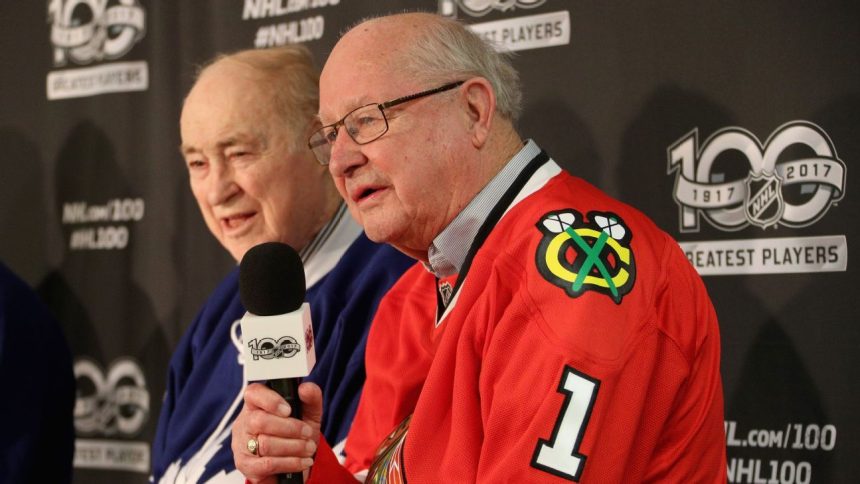
Born in Humboldt, Saskatchewan, Hall broke into the league with the Detroit Red Wings, winning the Calder Trophy as rookie of the year in 1956. He later became a foundational figure for Chicago, where his No. 1 jersey was retired in 1988. He was inducted into the Hockey Hall of Fame in 1975 and was later named among the NHL’s Top 100 Players during the league’s centennial celebrations.
Tributes poured in following the news of his death. Hall of Fame goalie Martin Brodeur called Hall “a legend” and credited him with setting the standard for generations that followed. NHL commissioner Gary Bettman praised Hall’s durability and influence, noting that his excellence stretched across multiple eras of the game.
The Blackhawks honored Hall with a moment of silence, dimming the lights and spotlighting his retired banner hanging in the rafters — a powerful reminder of a player whose legacy remains woven into the fabric of the franchise. St. Louis also paid tribute, remembering Hall as the steady presence who gave credibility and belief to a new NHL market.
Glenn Hall did not just play goaltender — he defined it. His resilience, innovation, and fearless commitment reshaped expectations for the position at a time when protection was minimal and pressure was relentless. Decades after his final game, his record still stands, his influence still echoes, and his place in hockey history remains unshakable.
At 94, Hall leaves behind more than trophies and numbers. He leaves a blueprint for greatness — one built on toughness, consistency, and unwavering pride in the crease.