







Jannik Sinner Unveils a Ruthless Evolution Ahead of the Australian Open
As the Australian Open gets underway, Jannik Sinner finds himself in a rare position: the hunter who has become the hunted. A two-time defending champion in Melbourne, Sinner enters the season’s first Grand Slam knowing that maintaining dominance at the very top of men’s tennis requires more than consistency — it demands evolution.
“There is little wrong with my game,” Sinner admitted. “But at the top level, small details make the difference.”
Those details are exactly what Sinner has been obsessing over.
Why Change Was Necessary
For much of the last two seasons, Sinner’s baseline game has been close to flawless. His ability to control rallies, win service games, and neutralize opponents on return made him statistically one of the most complete players on tour. Last year, he led the ATP in both percentage of service games won and return games won, a rare double that highlights total control.
Yet one obstacle kept resurfacing — Carlos Alcaraz.
Alcaraz has repeatedly exposed the limits of predictability. With a head-to-head edge of 10–6, including seven wins in their last nine meetings, Alcaraz has shown that raw power alone isn’t always enough. Even after Sinner’s breakthrough Wimbledon victory last summer, the Italian knew standing still was not an option.
“Immediately after losing to Carlos, I knew what I needed,” Sinner said. “Variety.”
The Numbers Behind the Transformation
According to Tennis Data Innovations, Sinner’s evolution isn’t theoretical — it’s measurable.
-
Shot variety increased from 11.7% to 13.7%, a 17% jump
-
Slice usage rose from 3.6% to 4.2%
-
Drop shots increased from 1.5% to 2%
-
Net approaches jumped from 3% to 4.3%, the biggest leap of all
While still below the tour average of 19.1%, these incremental gains are significant at elite level. Against players like Alcaraz, even a marginal increase in unpredictability can tilt matches decided by a handful of points.
Learning to Leave the Comfort Zone
Sinner’s changes are not drastic reinventions but carefully layered additions. He hasn’t abandoned his natural baseline strength — instead, he’s expanded around it.
“We worked a lot on trying to make the transition to the net,” Sinner explained at Melbourne Park. “During some tournaments, I didn’t serve-volley, didn’t use drop shots. Then you arrive at a point where you play Carlos, and you have to go out of your comfort zone.”
That comfort zone has long been Sinner’s biggest weapon — and his biggest limitation.
Against most of the tour, his relentless groundstrokes are enough. Against Alcaraz, who thrives on variety, improvisation, and chaos, predictability becomes a liability.
Inspired by the Greats
Sinner’s willingness to adapt places him in a long tradition of champions who reshaped their games to conquer specific rivals.
-
Roger Federer famously adjusted his tactics to counter Rafael Nadal
-
Andy Murray, under Ivan Lendl, added aggression and net play to reach the sport’s highest tier
-
Lendl himself spent years refining his net game to finally win Wimbledon
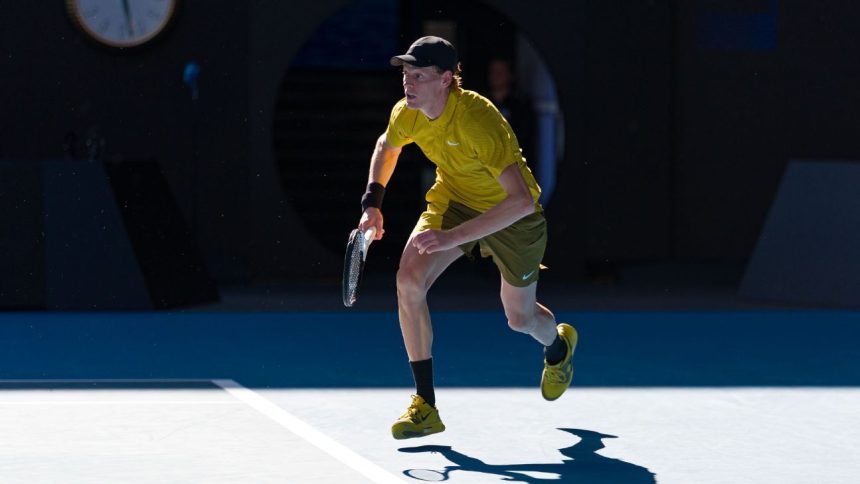
Jannik Sinner fine-tunes his game with added variety and aggression as he begins his Australian Open title defense
Sinner sees those examples not as blueprints, but as proof that evolution takes time — and patience.
“If you add something to your game,” he said, “the aim is to get better as a tennis player, not just to beat one guy.”
Physical and Mental Growth Go Hand in Hand
The modern game is unforgiving. Matches are faster, rallies longer, and physical demands higher than ever. Sinner understands that tactical growth must be matched by physical and mental resilience.
“We worked a lot physically,” he said. “And mentally — staying there, always focused. That’s very significant.”
This balance allows Sinner to introduce variety without overextending himself across a long season. Drop shots, net rushes, and slice backhands all require precise timing and fitness — tools that must be deployed selectively.
Why the Changes Matter Now
Sinner arrives in Melbourne having won four of his five tournaments after the US Open, including the ATP Tour Finals. Importantly, those wins didn’t come from abandoning his identity, but from enhancing it.
He mixed in more drop shots. He ventured forward more often. He accepted shorter points when opportunities arose. The result? The same dominant player — but harder to read, harder to trap, and harder to break.
Winning a third straight Australian Open would place Sinner in rare company, alongside Novak Djokovic as the only men in the Open Era to achieve that feat.
The Alcaraz Factor Looms Large
If Sinner reaches the final and Alcaraz stands across the net, the question won’t be about power or endurance — it will be about adaptability.
Alcaraz’s variety comes naturally. He loves the net, thrives on drop shots, and embraces unpredictability. Sinner, by contrast, has had to learn variety deliberately, step by step.
Read Also : SmackDown Shake-Up: 5 Must-Know Ways to Watch WWE SmackDown on Its Explosive New TV Home This February
But that learning curve may now be reaching its payoff.
“When you’re at the top,” Sinner said, “small details make the difference.”
As his Australian Open title defense begins, those details — subtle, calculated, and quietly ruthless — may determine whether Jannik Sinner remains the man to beat in Melbourne, or simply the man everyone is chasing.