







Australian Open 2026 Delivers Fireworks as Carlos Alcaraz Takes On Alex De Minaur
MELBOURNE — When Carlos Alcaraz and Alex De Minaur walked onto Rod Laver Arena for their Australian Open 2026 quarterfinal, the matchup promised far more than just a battle for a semifinal spot. It was a clash of philosophies, athleticism, and belief — the world No. 1 against Australia’s greatest home hope, both playing some of the best tennis of their careers under brutal Melbourne heat.
On paper, the numbers leaned heavily in Alcaraz’s favor. He entered the match with a dominant head-to-head record, unbeaten against De Minaur and undefeated in sets throughout the tournament. But anyone who has watched De Minaur closely knows statistics rarely tell the full story when he steps on court, especially in front of a roaring Australian crowd.
A Match Defined by Movement and Margins
What immediately stood out was the sheer speed on display. De Minaur is widely regarded as one of the fastest players in the world, perhaps the only man capable of matching Alcaraz step for step in court coverage. Rallies stretched, points twisted in unexpected directions, and the crowd gasped repeatedly as both players chased down balls that would be winners against almost anyone else.
Yet there was a key difference: power and finishing ability.
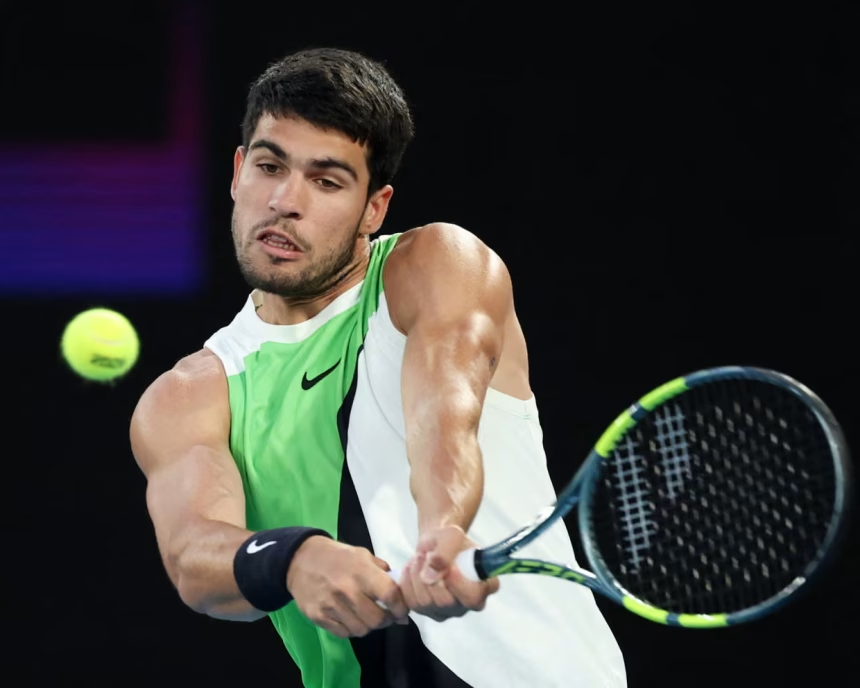
Alcaraz doesn’t just defend — he transitions from defense to offense in an instant. While De Minaur worked tirelessly to stay in points, Alcaraz consistently found ways to end them. His forehand, heavy and explosive, repeatedly pushed the Australian back, while his backhand down the line proved decisive in critical moments.
Even when De Minaur played aggressively — something he has consciously worked on over the past year — Alcaraz still had another gear.
De Minaur’s New Belief
This version of Alex De Minaur is not the same player who previously struggled in Grand Slam quarterfinals. Now ranked a career-high No. 6, the Australian has added bite to his game, flattening out his groundstrokes and stepping closer to the baseline. He no longer wants to be a “punching bag” against big hitters — and it shows.
Throughout the match, De Minaur refused to back down. He went after returns, mixed in drop shots — particularly effective against Alcaraz, who dislikes being dragged forward unexpectedly — and fed off the crowd’s energy. Every hold of serve was met with thunderous applause, every extended rally felt like a small victory.
There were moments when belief surged. Break points were created. Pressure was applied. And for brief stretches, Rod Laver Arena genuinely believed an upset was possible.
Alcaraz’s Composure Sets Him Apart
But what separates Alcaraz from almost everyone else on tour is his composure in chaos.
Even when his first-serve percentage dipped or De Minaur forced extended rallies, Alcaraz never panicked. He absorbed pressure, trusted his patterns, and waited for the slightest opening. When it came, he struck — often with devastating precision.
Australian Open 2026 Quarterfinal Clash Sees Carlos Alcaraz and Alex De Minaur Push Each Other to the Limit
There were games where De Minaur did everything right, only for Alcaraz to erase it with a single, jaw-dropping winner. A forehand whipped cross-court. A backhand laser down the line. A perfectly disguised drop shot. The Spaniard has an uncanny ability to make elite tennis look almost playful.
As one rally after another ended with Alcaraz stepping forward to finish at the net, the difference between “world-class” and “world No. 1” became clear.
The Crowd, the Heat, and the Atmosphere
Conditions added another layer to the contest. With temperatures still hovering above 35°C well into the evening, the physical toll was immense. The Rod Laver roof remained open, and both players were visibly tested by the heat.
The crowd, firmly behind De Minaur, did everything possible to lift their man. Every sprint, every fist pump, every defiant hold was celebrated. De Minaur thrives in these moments — the noise fuels his fight.
Alcaraz, though, has grown comfortable playing the villain. He smiled, nodded, and raised his level when the crowd surged, silencing the stadium with breathtaking shot-making.
The Mental Edge
Perhaps the most decisive factor was the mental battle. De Minaur entered his seventh Grand Slam quarterfinal still searching for his first win at this stage. Alcaraz, by contrast, has lived in these moments for years, winning majors and handling expectation with remarkable maturity for someone still so young.
When the match tightened, Alcaraz leaned into his experience. De Minaur, despite his growth, blinked at a few critical moments — a mistimed forehand here, a slightly rushed decision there. Against Alcaraz, margins are unforgiving.
What This Match Means Going Forward
For Carlos Alcaraz, the victory pushes him one step closer to history. With the chance to become the youngest man to complete a career Grand Slam, his focus remains sharp and unwavering. Each round in Melbourne has reinforced the sense that he is raising the bar in men’s tennis alongside rivals like Jannik Sinner.
For Alex De Minaur, the result may sting — but it also confirms his progress. He didn’t fold. He didn’t retreat. He competed toe-to-toe with the best player in the world and showed that he belongs on this stage.
The gap is still there, but it’s narrowing.
Final Takeaway
This quarterfinal wasn’t just about who advanced. It was about where men’s tennis is heading — relentless athleticism, fearless aggression, and razor-thin margins. De Minaur brought heart, speed, and belief. Alcaraz brought power, touch, and championship composure.
In the end, Carlos Alcaraz was simply too complete. But Australia’s home hope left the court knowing he had pushed the world No. 1 — and that belief, more than any statistic, may be the foundation of what comes next.